01
Make reasoning visible
Do not automate away the thinking students are expected to learn. Expose structure, equations, assumptions, and meaningful errors where they support understanding.
Systemika is an initiative to develop open, pedagogically informed tools for teaching and learning system dynamics—designed around the reasoning learners need to develop, not only the models they need to produce.
An evolving community initiative, not a single finished product.
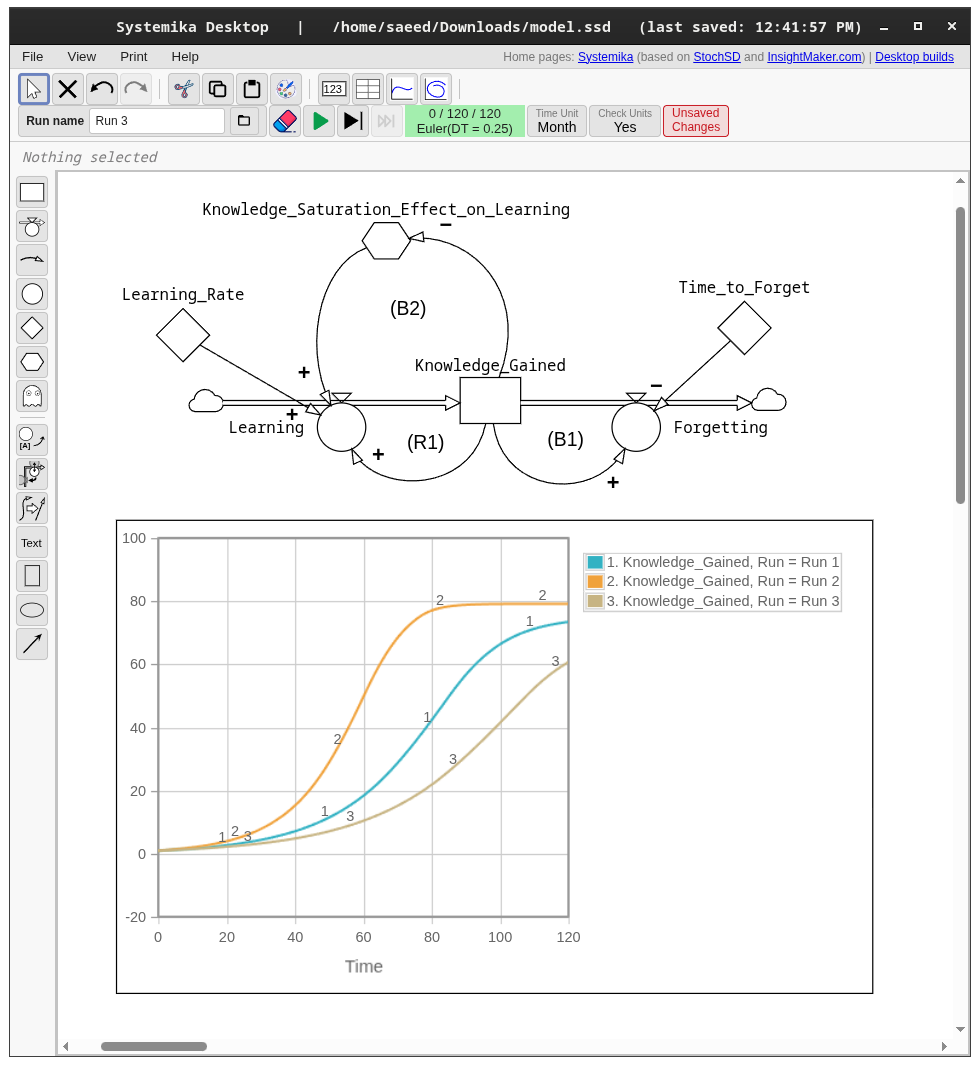
Most system dynamics software is built to help experienced modelers work efficiently. Education poses a different problem. Beginners are developing causal reasoning, understanding accumulation and delays, learning formulation, making mistakes, and connecting structure to behavior. The software environment shapes all of that.
Do not automate away the thinking students are expected to learn. Expose structure, equations, assumptions, and meaningful errors where they support understanding.
Educators should be able to decide which capabilities appear, when assistance is introduced, and how feedback and representations align with learning objectives.
Students should be able to continue using, inspecting, adapting, and sharing their tools and models beyond a particular course, institution, or license.
The Systemika research agenda frames educational modeling software as a pedagogical environment. These eight considerations guide how tools can support competence as it develops.
 Systemika Studio
 provides the core environment students need to construct, run, inspect, and compare system dynamics models while leaving room for the educational capabilities described by the wider Systemika agenda.
Systemika is intended to grow as an ecosystem of focused educational tools. A single package does not need to solve every learning problem; individual tools can stay simple while sharing models, data, and instructional ideas through open standards.
Core model construction, simulation, visualization, and run comparison.
Focused practice in recognizing and describing patterns of behavior over time.
Purpose-built activities for accumulation, rates, and stock–flow identification.
Exercises for equations, units, assumptions, and connections between structure and behavior.
Systemika grew from a broader question: if system dynamics treats modeling as a process of learning, how should the environments used to learn modeling be designed?
Saeed P. Langarudi · Shahin Ashkiani · Filipe Medeiros · Millie Selvig-Larsen · Raafat Zaini
The initiative brings together system dynamics education, modeling, economics, design, data science, public policy, and technology. The current conceptual work has been developed collaboratively by the authors of the Systemika paper.
System dynamics modeling and pedagogy, model-based policy analysis, computational modeling in education and sustainability.
System dynamics, heterodox economics, data science, educational software, and open education.
Ecological economics, political economy, and simulation modeling for complex societal problems.
System dynamics education, human-centered design, design theory, public policy, and public health.
System dynamics education, software development, modeling social phenomena.
Systems thinking, simulation, AI, innovation, organizational design, immersive learning, and accessibility.
Systemika is intended as a collaborative effort. Educators, students, researchers, designers, and developers can contribute ideas, test educational approaches, improve existing tools, or build new ones.